Table of Contents
ToggleHere is what a clearinghouse really does, how it fits into your billing, and how to tell whether you need one or already have the problem solved.
What is a medical billing clearinghouse?
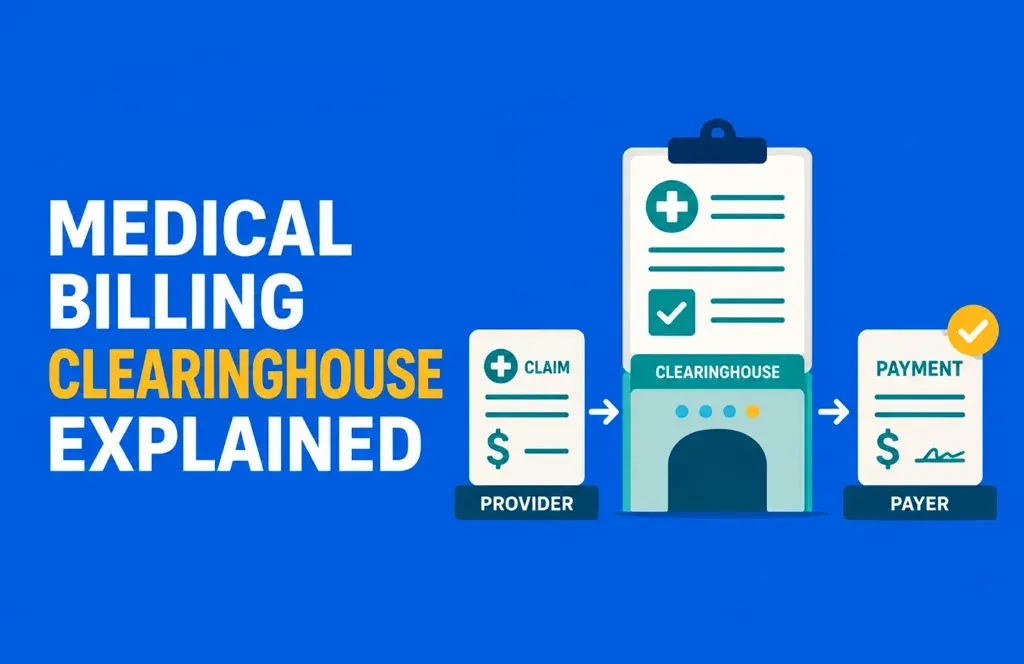
A clearinghouse is an organization that sits between healthcare providers and payers and moves claim data between them. Its defining job is translation. Your practice management system produces claim data in one format, each payer expects it in a specific standardized format, and the clearinghouse converts one into the other so the two sides can actually talk.
That role is not just technical, it is legal. Under HIPAA, a clearinghouse is one of the three types of covered entities, alongside providers and health plans, and it is the only one whose core function is translating between standard and non-standard transaction formats. In plain terms, it is a HIPAA-regulated pipe built specifically to carry your claims safely.
How a medical billing clearinghouse works
Think of a single claim moving through the system. You see the visit, your biller codes and enters the charge, and the claim leaves your software. What happens next is where the clearinghouse earns its keep.
Claim scrubbing and error checking
Before anything goes to a payer, the clearinghouse scrubs the claim. It runs the file against a set of edits, checking for missing fields, invalid codes, mismatched patient details, and payer-specific rules that would otherwise trigger a denial. If something is wrong, the claim comes back to you to fix before it ever reaches the insurer. That single loop is why electronic claims fail far less often than paper ones. Paper claims carry error rates around 28%, while claims run through a clearinghouse typically land in the low single digits.
EDI translation and secure transmission
Once a claim passes scrubbing, the clearinghouse converts it into the standard electronic data interchange (EDI) format payers use, the 837 file, and transmits it securely to the correct payer. The reverse trip matters just as much. When the payer responds, it sends back an 835 file, the electronic remittance advice, which tells you what was paid, what was adjusted, and why. The clearinghouse also handles the eligibility (270 and 271) and claim status (276 and 277) transactions that let you check coverage and follow a claim without calling the insurer.
Status tracking and remittance
A good clearinghouse does not just fire claims off and go quiet. It confirms the payer received each claim, tracks its status through the payer’s system, and surfaces rejections quickly so nothing sits unnoticed until the filing deadline passes. This visibility is the difference between catching a stuck claim on day three and discovering a batch of them at month end.
What a clearinghouse does for your revenue cycle
The value shows up in three places: speed, accuracy, and workload. Electronic submission through a clearinghouse can cut reimbursement times to under ten days, compared with the weeks a paper process can take. Fewer errors reach the payer, so your first-pass acceptance rate climbs and your denial volume drops. And because rejections come back with clear reasons attached, your team spends less time guessing why a claim failed and more time fixing it.
None of that eliminates denials on its own. A clearinghouse catches format and eligibility problems, but it cannot fix a coding decision or a missing authorization upstream. It is one strong layer of defense, which is why practices that pair it with a disciplined denial management process see the biggest gains.
Clearinghouse vs submitting directly to payers
You can skip a clearinghouse and submit claims directly to each payer through its own portal. For a practice that bills a single payer, that can even make sense. The trouble starts when you have many payers, because direct submission means learning and maintaining a separate connection, portal, and set of rules for each one.
A clearinghouse consolidates all of that into one connection. You send every claim to one place, and it fans them out to hundreds of payers in the format each expects. Direct submission trades a monthly clearinghouse cost for a heavier administrative load and less visibility, and for most multi-payer practices that trade is not worth it.
Is a clearinghouse the same as a billing service?
This is the point that confuses providers most, so it is worth being blunt. A clearinghouse and a billing service are not the same thing, and one does not replace the other.
A clearinghouse is the technology layer that transmits and validates claims. It does not code your visits, decide which modifier applies, chase a payer that underpaid you, or work a denial to resolution. A billing service does all of that human, judgment-heavy work: coding, submission strategy, follow-up, appeals, patient billing, and reporting. A billing service uses a clearinghouse as one of its tools. When you outsource billing, the clearinghouse is usually included and managed on your behalf, so you get the technology and the people running it together rather than a portal you still have to operate yourself. That is the practical difference between buying a billing outsourcing relationship and buying a clearinghouse subscription.
Do you actually need a clearinghouse?
Legally, no. Providers are not required to use a clearinghouse to submit claims. In practice, almost every practice uses one, directly or through their billing partner, because the alternative is slower, more error-prone, and harder to monitor.
The honest question is not whether you need the technology, but whether you should manage it yourself. Running your own clearinghouse means you own the setup, the payer enrollment, the rejections, and the troubleshooting when a connection breaks. Some practices have the staff and appetite for that. Many, especially smaller ones, would rather the whole claim pipeline just work without becoming another job. Purpose-built billing support for small practices exists largely so owners do not have to become clearinghouse administrators on top of seeing patients.
How to choose a clearinghouse (or let a partner handle it)
If you are evaluating a clearinghouse directly, a handful of factors separate a good fit from a future headache.
Start with payer coverage, because a clearinghouse that does not connect to your top payers, including regional Medicaid plans, is useless no matter how polished it looks. Check how well it integrates with your EHR or practice management system, since native integration prevents the duplicate data entry that creates errors. Look at the first-pass claim rate it helps practices achieve, with 95% or higher being the mark of a strong platform. Weigh the support model, favoring phone and live chat over email-only, and read the pricing carefully for setup fees, per-transaction charges, and long contract lock-ins. Confirm HIPAA and, ideally, SOC 2 compliance, since this pipe carries protected health information.
If that list reads like a second job, that is the real argument for handing it off. When billing runs through a full-service partner, the clearinghouse decision, enrollment, and day-to-day management come bundled with the people who work your claims and your denials. A quick revenue cycle review will tell you whether your current setup is helping or quietly costing you, and where a cleaner claim pipeline would recover money you are leaving on the table.
Whichever route you take, the goal is the same. A medical billing clearinghouse should make your claims faster, cleaner, and easier to track, not add another system for your team to babysit. Understand what it does, decide whether you want to run it or have it run for you, and make sure the step your patients never see is the one working hardest for your revenue.
Frequently Asked Questions
What is a medical billing clearinghouse?
It is an organization that sits between providers and payers, checking claims for errors and translating them into the standardized electronic format each insurer requires before securely transmitting them. Under HIPAA it is a covered entity built specifically to move claim data.
How does a clearinghouse work in medical billing?
Your claim leaves your software, the clearinghouse scrubs it for errors, converts it to the 837 EDI format, and sends it to the payer. It then tracks the claim’s status and delivers the payer’s electronic remittance (835) back to you.
Is a clearinghouse the same as a medical billing company?
No. A clearinghouse is the technology that validates and transmits claims. A billing company does the coding, submission, follow-up, and denial work, and it uses a clearinghouse as one of its tools. Outsourcing billing usually includes the clearinghouse, managed for you.
Do you need a clearinghouse for medical billing?
It is not legally required, but nearly every practice uses one because it is faster and more accurate than submitting to each payer directly. The real choice is whether to manage it yourself or have a billing partner handle it.
What is the difference between a clearinghouse and direct billing?
Direct billing means submitting claims through each payer’s own portal, which means a separate connection for every payer. A clearinghouse consolidates all payers into one connection and routes claims in the correct format to each.
Is a clearinghouse HIPAA compliant?
A clearinghouse is a HIPAA covered entity and is legally obligated to protect health information. When choosing one, confirm its HIPAA compliance and look for SOC 2 certification as an added security standard.