
Table of Contents
ToggleChoosing between in-house vs outsourced medical billing is not simply a choice between paying a salary and paying a service fee. The better model is the one that produces more collectible revenue after staffing, technology, denials, compliance work, and management time are counted.
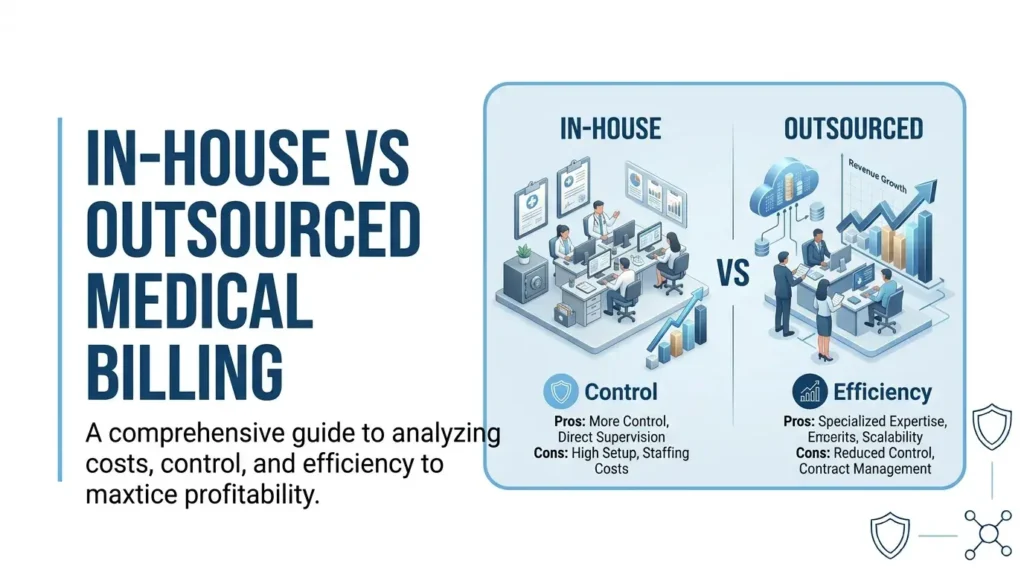
In-house billing gives a practice direct control over its people and workflows. Outsourcing gives it access to a larger billing operation without building that department internally. Small and growing practices often benefit from outsourcing, while larger groups with experienced managers and enough claim volume may support an efficient internal team. A hybrid arrangement can also work when a practice wants to keep patient-facing tasks in-house but needs help with coding, denials, or aged accounts receivable.
Quick Comparison: In-House vs Outsourced Medical Billing
| Factor | In-House Billing | Outsourced Billing |
|---|---|---|
| Cost structure | Fixed payroll, benefits, software, training, and management costs | Usually a percentage of collections, per-claim fee, or monthly fee |
| Control | Direct supervision and fast access to staff | Control depends on contract terms, reporting, and communication |
| Staffing risk | Absence or resignation can interrupt billing | Vendor is responsible for staffing and coverage |
| Specialty expertise | Depends on the people the practice can recruit and retain | Can provide specialty-focused coders and payer knowledge |
| Scalability | Growth may require hiring and training | Resources can usually expand with claim volume |
| Data access | Practice manages its own systems and reports | Access must be protected in the service agreement |
| Best fit | Well-managed groups with stable volume and a strong billing department | Practices seeking predictable coverage, expertise, and less administrative burden |
No row in this table decides the answer by itself. A practice can have excellent internal billers and poor management, or a reputable vendor and a weak contract. The decision requires both cost and performance data.
What Is In-House Medical Billing?
With in-house billing, the practice employs and manages the people responsible for its revenue cycle. Depending on size, that work may include insurance verification, charge entry, coding, claim submission, payment posting, denial appeals, patient statements, and A/R follow-up.
A solo practice may assign much of this work to one employee who also supports the front desk. A multi-location group may have separate coders, billers, payment posters, denial specialists, and a revenue cycle manager. Those are both called in-house billing, but their resilience and cost are very different.
The main operational risk is concentration. If one person knows the payer portals, unresolved denials, and claim work queues, a vacation or resignation can slow cash flow quickly. A durable internal department needs written workflows, cross-training, documented payer contacts, and backup ownership for every critical queue.
What Is Outsourced Medical Billing?
Outsourced billing transfers some or all billing functions to an external company. A full-service partner may handle claim review and submission, payment posting, denial management, appeals, patient billing, reporting, and accounts receivable recovery. The practice still owns clinical documentation, charge capture, and oversight of the vendor.
Outsourcing does not mean giving up responsibility for the revenue cycle. Someone inside the practice should still review reports, resolve documentation questions, monitor payer trends, and hold the company to agreed service levels. The difference is that the practice manages a vendor relationship instead of recruiting and supervising an entire billing department.
A billing company that receives protected health information generally acts as a business associate. HHS explains that a covered entity must have a written agreement defining permitted uses of the information and requiring appropriate safeguards. Review the vendor’s business associate agreement, security responsibilities, subcontractor provisions, and procedures for returning data when the relationship ends. The HHS sample business associate provisions provide a useful reference, although they do not replace legal advice.
The True Cost of In-House vs Outsourced Medical Billing
A fair comparison uses total cost to collect, not one salary versus one percentage. It also separates unavoidable clinical costs from billing costs. For example, an EHR may remain necessary under either model, while a separate claim-scrubbing tool may be included in an outsourcing agreement.
In-house staffing and overhead
The internal budget starts with wages but cannot stop there. Add payroll taxes, benefits, paid leave, recruitment, training, certification, management time, workstations, software, clearinghouse charges, and coverage when an employee is unavailable.
For context, the U.S. Bureau of Labor Statistics reported a median annual wage of $50,250 for medical records specialists in May 2024. That category is broader than medical billers, and actual pay varies by market, experience, certification, and role. Still, it shows why a salary-only comparison understates the cost of a capable internal function. See the current BLS occupational data when building a local staffing estimate.
Outsourced billing pricing models
Billing companies commonly charge a percentage of collected revenue. Others use a per-claim rate, a flat monthly fee, or a hybrid structure. The headline percentage is meaningful only after you identify the denominator and included work.
Ask whether the fee applies to insurance payments, patient payments, total net collections, or another amount. Then confirm whether coding, denial appeals, statements, old A/R, credentialing, clearinghouse charges, and reporting are included. A lower rate with multiple add-on fees may cost more than a higher all-inclusive proposal.
Hidden costs on both sides
Internal billing can hide the cost of management attention, vacant positions, delayed follow-up, and claims written off because nobody worked them before a filing or appeal deadline. Outsourced billing can hide implementation fees, minimum monthly charges, interface work, postage, early termination provisions, and charges for exporting data.
Both models can also lose money through weak front-end processes. Incorrect demographics, inactive coverage, missing authorizations, and incomplete documentation do not disappear when claims move to another team. A good billing arrangement defines who owns each step and how quickly errors return to the practice for correction.
A simple cost calculation
Suppose a practice collects $1,000,000 per year. An outsourced proposal at 6% would produce a base service fee of $60,000 before any excluded services. The comparable internal cost should include the fully loaded compensation of every employee who performs billing, the relevant technology, training, recruitment, and the time a manager spends supervising the function.
Then compare performance. If one model costs less but leaves more collectible balances unresolved, the apparent saving is not a saving. Use the same 12-month period and measure net collections, denial rate, days in A/R, A/R over 90 days, write-offs, and the cost to collect. These figures are illustrative, not a quote or performance prediction.
In-House Medical Billing Pros and Cons
The strongest advantage of an internal team is direct access. Billers can speak with clinicians and front-office employees immediately, learn local workflows, and flag documentation problems while the encounter is still fresh. Management can change priorities without waiting for an external account team.
In-house staff may also understand unusual payer arrangements and patient needs that take time for a vendor to learn. Practices with stable volume, experienced leadership, documented procedures, and enough employees to provide backup coverage can build an effective department.
The drawbacks are fixed overhead and dependence on hiring. One strong biller is valuable, but one strong biller is also a single point of failure. Small teams may struggle to keep daily claims current while also working denials, underpayments, and old balances. Growth then creates another hiring cycle before the additional revenue is fully collected.
Technology and compliance also require continuous attention. The practice must manage access controls, training, payer changes, coding updates, interfaces, and reporting. Direct control is useful only when leadership has time and expertise to exercise it.
Outsourced Medical Billing Pros and Cons
Outsourcing converts much of the billing operation from fixed staffing into a contracted service. It can give a small practice access to backup coverage, specialists for denials and payment posting, established payer workflows, and broader reporting without hiring each role separately.
It is particularly useful when claim volume changes, a practice adds providers, or an internal backlog has begun to age. A company offering full healthcare revenue cycle management can coordinate work across claim submission, payments, denials, and follow-up rather than treating each queue as an isolated task.
The tradeoff is dependence on vendor quality. Slow communication, generic coding knowledge, frequent account-manager turnover, or limited report access can erase the expected benefit. Outsourcing also does not repair poor documentation or registration unless the scope includes processes that address those problems.
Contract terms matter. The practice should retain access to its data, understand termination and transition requirements, and receive reports detailed enough to verify performance. Avoid choosing a company based only on the lowest percentage.
Performance Comparison Beyond Price
Reviewing performance protects the practice from a false economy. The following measures should be calculated consistently under either model:
- Clean claim rate: the share of claims accepted without preventable correction or resubmission.
- Denial rate: denials divided by submitted or adjudicated claims, with the exact method stated.
- Days in A/R: the average time charges remain outstanding.
- A/R over 90 days: the portion of receivables that has moved into older aging buckets.
- Net collection rate: the amount collected compared with the amount contractually collectible.
- Cost to collect: all billing expenses divided by collections.
Do not accept a dashboard without definitions. A vendor and an internal manager can calculate the same metric differently. Reports should also allow analysis by payer, provider, location, procedure, denial reason, and aging bucket. Averages alone can conceal a serious problem with one payer or service line.
Denial work deserves particular attention. The goal is not only to appeal individual claims. A reliable process identifies repeat causes, sends corrections back to registration or clinical teams, and confirms that the same error declines over time. Practices with recurring unresolved denials may need dedicated denial management services even if the rest of billing remains internal.
When In-House Billing Makes More Sense
Keeping billing in-house can be the better choice when the practice has sufficient, stable volume to use a complete team rather than rely on one generalist. It also needs a manager who understands revenue cycle performance and has authority to correct front-end and clinical workflow problems.
Strong candidates already know their key metrics, maintain low and well-explained denial levels, work older receivables consistently, and have backup coverage. They can recruit specialty-experienced staff and support the necessary software and training. If the department performs well, outsourcing solely to reduce the visible payroll line may create disruption without improving net revenue.
When Outsourcing Makes More Sense
Outsourcing is worth serious consideration when billing depends on one employee, claims are not submitted promptly, denials repeat without root-cause correction, or A/R is aging faster than staff can work it. It can also support a practice that is adding providers or locations and does not want billing capacity to lag behind growth.
Small practices often face a difficult staffing equation. They need experienced billing support, but their volume may not justify several specialized employees plus backup coverage. In that setting, medical billing services for small practices can provide broader capability while allowing internal staff to focus on patients and front-office accuracy.
The case becomes stronger when a specialty has complex coding, authorization, modifier, or payer rules. Confirm that any prospective company has current experience with the actual specialty and payer mix. General billing experience is not a substitute for knowing the claims a practice submits every day.
Can a Hybrid Billing Model Work?
A hybrid model divides responsibility. The practice might keep scheduling, eligibility, patient collections, and documentation coordination in-house while outsourcing coding, claim submission, denials, and old A/R. Another group may retain its billing team but bring in temporary help for a backlog or a new location.
This approach can preserve patient-facing control while adding technical depth. Its weakness is the handoff. Every task needs one owner, a deadline, and an escalation route. If both teams assume the other is correcting rejected claims or contacting a provider, balances will age in the gap.
How to Evaluate Your Current Billing Model
Begin with a 12-month baseline. Pull total charges, contractual adjustments, collections, denials, write-offs, A/R by aging bucket, and billing expenses. Separate expected contractual adjustments from preventable write-offs such as timely filing losses or unresolved authorization failures.
Next, trace a sample of claims from encounter to payment. Look for delays between date of service, charge entry, claim submission, denial receipt, correction, appeal, and final resolution. A monthly total can look acceptable while individual claims repeatedly stall for weeks.
Finally, test resilience. Ask what happens if the lead biller is unavailable for 30 days, claim volume rises 25%, a payer changes its rules, or the practice opens another location. The model should handle predictable disruptions without allowing daily submissions or follow-up to stop. A professional medical billing audit can establish this baseline before the practice changes staffing or signs a contract.
What to Ask an Outsourced Billing Company
- Which functions are included, and which produce separate charges?
- Who will manage the account, and what is the escalation process?
- Which specialties, payers, EHRs, and practice management systems does the assigned team use regularly?
- How are rejected and denied claims tracked, corrected, appealed, and reported?
- Which metrics appear in monthly reports, and how is each one calculated?
- Will the practice retain full access to claim, payment, and A/R data?
- What are the BAA, security, subcontractor, breach notification, and access-control procedures?
- What happens to open claims, reports, and data when the agreement ends?
Request written answers and a complete fee schedule. References should come from practices with a similar specialty and size, not only from the vendor’s easiest accounts.
How to Switch Without Disrupting Cash Flow
A transition should overlap responsibilities instead of cutting from one team to another on a single date. Inventory unsubmitted encounters, rejected claims, denials, unapplied payments, credit balances, and every A/R aging bucket. Decide who owns each item created before and after the cutover date.
Confirm payer enrollments, electronic remittance settings, clearinghouse connections, bank information, system access, and provider rosters before new claims move. Keep the old billing environment available long enough to reconcile payments and finish open work. Daily monitoring during the first weeks is more useful than waiting for the first monthly report.
Do not let the outgoing company close balances simply because responsibility is changing. Export detailed claim notes and reports in usable formats, then reconcile beginning A/R with the new team’s opening inventory.
Which Billing Model Is Right for Your Practice?
Choose in-house billing when you have the volume, people, technology, and management discipline to operate a complete revenue cycle department. Choose outsourcing when specialist capacity, staffing continuity, scalability, or stronger follow-up is more valuable than direct daily supervision. Consider a hybrid model when patient-facing processes work well but coding, denials, or aged A/R need additional depth.
The decision should come from your numbers. Swift Medical Billing can review billing costs, denials, aging, and collection workflows to identify where revenue is being delayed or lost. Request a free billing audit before changing your in-house vs outsourced medical billing model.
Frequently Asked Questions
What percentage do medical billing companies charge?
Many companies use a percentage of collections, while others charge per claim or use a monthly fee. Rates vary with specialty, volume, claim complexity, and included services. Compare the complete scope and fee schedule rather than treating the percentage as the total price.
How much does in-house medical billing cost per year?
The cost depends on local wages and the size of the department. Include compensation, payroll costs, benefits, paid leave, recruiting, software, clearinghouse fees, training, equipment, and management time. Revenue lost through delayed or unresolved claims should be measured separately when comparing performance.
At what practice size does outsourcing make financial sense?
There is no universal provider threshold. Lower-volume practices often struggle to justify a fully staffed department with backup coverage, while larger groups may spread internal fixed costs across more claims. Calculate total cost to collect and compare performance using the practice’s own annual collections and claim mix.
What is a hybrid medical billing model?
A hybrid model keeps some revenue cycle functions inside the practice and outsources others. A common arrangement keeps scheduling, eligibility, and patient communication internal while a billing partner handles coding, claims, denials, or A/R follow-up.
What hidden costs should practices watch for?
Internal hidden costs can include turnover, backup coverage, management time, training, and delayed follow-up. Outsourcing agreements may include implementation, minimum monthly, statement, interface, old A/R, termination, or data-export charges. Ask for all costs in writing.
How long does it take to see results after outsourcing?
The timeline depends on the condition of the existing A/R, payer enrollments, documentation quality, system access, and the quality of the transition. Establish baseline metrics before the change, then monitor claim submission, rejections, denials, days in A/R, and collections during and after implementation.