
Table of Contents
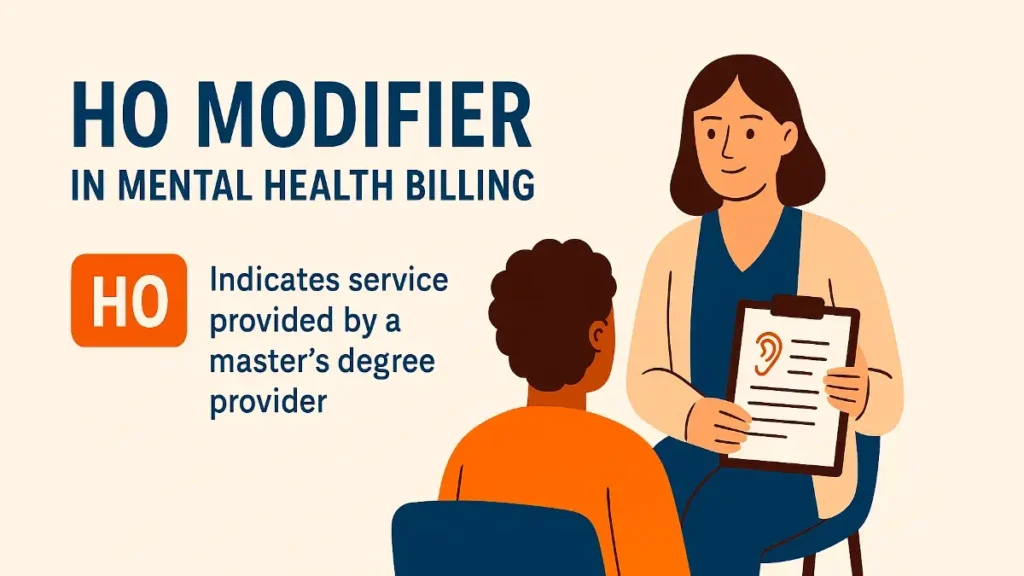
ToggleThe HO modifier for behavioral health identifies a service performed by a master’s degree level clinician. Payers use this two-character HCPCS modifier to understand who delivered the service and, in some programs, which reimbursement rule applies. HO is common in Medicaid behavioral health and ABA billing, but it is not required on every claim or accepted by every payer.
What Does the HO Modifier Mean in Behavioral Health Billing?
HO means master’s degree level. It describes the education level of the individual who rendered a behavioral health service. The base CPT or HCPCS code still explains what happened during the encounter. HO adds information about the clinician.
For example, H2011 describes crisis intervention service, per 15 minutes. If a state Medicaid program requires a credential modifier and the service was delivered by an eligible master’s level clinician, the claim may be submitted as H2011-HO. The exact requirement comes from the payer manual, fee schedule, contract, or authorization, not from the modifier definition alone.
The HCPCS modifier reference identifies HO as master’s degree level. Related modifiers include HM for less than a bachelor’s degree, HN for bachelor’s degree level, and HP for doctoral level. The HCPCS Level II modifier reference is useful for definitions, but payment rules still depend on the individual payer.
When Should You Use the HO Modifier?
Use HO only when the rendering clinician meets the payer’s definition of a master’s level provider and the payer instructs you to report it with the billed service. This often applies to services delivered through a community mental health center, behavioral health organization, Medicaid program, or ABA network.
Mental Health and Psychotherapy Services
Depending on the plan, eligible clinicians may include licensed professional counselors, licensed clinical social workers, licensed marriage and family therapists, or other independently licensed and supervised professionals with qualifying graduate education. A degree by itself does not guarantee eligibility. The clinician may also need an active license, approved taxonomy, individual NPI, and enrollment under the billing organization.
Many commercial psychotherapy claims do not need HO. Before adding it to codes such as 90791, 90834, or 90837, confirm that the payer recognizes credential-level modifiers for that provider type. Payer-specific rules are central to accurate mental health billing services.
Medicaid-Funded Behavioral Health Services
HO appears most often in state Medicaid rules. One state may require it with a community-based HCPCS code, while another may use a different modifier or rely on taxonomy and enrollment data. Managed Medicaid plans can also maintain rules that differ from the state’s fee-for-service program.
Missouri provides a clear example of state-specific treatment. Its Medicaid guidance requires HO for certain ABA claims billed by behavior analysts and psychologists, while HN and HM identify other practitioner levels. The MO HealthNet psychotherapy and ABA guidance shows why a national modifier definition cannot replace the applicable state manual.
ABA Services
Some ABA plans use HO for a BCBA or another master’s level qualified health professional. Others define eligible roles differently. Check the authorization, rendering provider instructions, and code-specific policy for 97151 through 97158.
Which Providers Qualify for the HO Modifier?
Qualification depends on more than the diploma. A payer may require a specific license category, supervision arrangement, specialty taxonomy, or enrollment status. An LPC, LCSW, LMFT, BCBA, or associate-level clinician might qualify under one contract but not another.
Before the first claim, confirm the degree, license effective date, taxonomy, group affiliation, and rendering NPI. If those records do not match, HO can expose the mismatch instead of fixing it. Reliable medical credentialing services help keep enrollment data aligned with the claim.
HO vs. Other Behavioral Health Modifiers
| Modifier | General meaning | How it differs from HO |
|---|---|---|
| HM | Less than bachelor’s degree level | Reports a lower education tier when recognized by the payer |
| HN | Bachelor’s degree level | Identifies a bachelor’s level practitioner rather than a master’s level practitioner |
| HO | Master’s degree level | Identifies the education level of the rendering clinician |
| HP | Doctoral level | Reports a doctoral level practitioner |
| AH | Clinical psychologist | Identifies a professional type, not simply a master’s level |
| AJ | Clinical social worker | Identifies a provider category and may not be interchangeable with HO |
| HE | Mental health program | Describes the program context rather than the clinician’s degree |
| HF | Substance abuse program | Describes the treatment program rather than provider education |
HO can sometimes appear with a program modifier such as HE or HF. It may also be paired with a telehealth modifier such as 95 when the payer requires both credential and delivery information. Modifier order matters because a payer may process pricing modifiers before informational modifiers.
How to Bill a Claim With the HO Modifier
On the CMS-1500 form, enter modifiers in Box 24D after the procedure code. An electronic 837P claim places procedure modifiers in the SV101 composite at the service-line level. Most billing systems provide separate fields for the base code and each modifier position.
For a master’s level clinician delivering an authorized service by synchronous video, one payer might expect HO and 95. Another may want only 95 or rely on the place of service code. Never copy a modifier combination from a similar claim without checking the plan.
How HO Can Affect Reimbursement
Some payers use HO to select a credential-specific fee schedule. Others use it for reporting or claim validation without changing the allowed amount. An omitted modifier can cause a denial, underpayment, or failure to match the claim to an authorization. An unsupported HO can cause a provider-level mismatch, overpayment, or post-payment recoupment.
Review the remittance advice rather than assuming the procedure code was wrong. The CARC and RARC combination may point to an invalid modifier, provider mismatch, missing authorization, or enrollment problem. A focused medical billing audit can reveal whether the error affects one payer or an entire provider population.
Common HO Modifier Denials and How to Correct Them
The most common failures begin with a correct modifier applied under the wrong payer rule. Other problems include an incorrect modifier position, an ineligible rendering provider, inactive enrollment, a taxonomy mismatch, or a claim that does not match the authorization.
- Read the complete denial message and identify the affected service line.
- Compare the submitted claim with the payer manual, fee schedule, authorization, and provider contract.
- Verify the rendering provider’s degree, license, taxonomy, NPI, and enrollment effective date.
- Correct and resubmit the claim within the payer’s filing limit, or appeal when the original coding was supported.
- Update the billing rule so the same error does not recur across future claims.
Do not remove HO merely to force a claim through the clearinghouse. Clearinghouse acceptance only confirms that the claim format passed initial edits. It does not prove that the modifier meets the payer’s coverage and reimbursement policy. When patterns persist, structured denial management services can separate coding issues from authorization and enrollment failures.
Documentation and Credentialing Requirements
The clinical note should support the encounter date, duration when applicable, treatment, medical necessity, and rendering clinician. Credential records should support education, license, supervision, taxonomy, enrollment, and group affiliation.
HO does not replace the rendering NPI or cure an enrollment gap. Keep payer approval letters and effective dates accessible to credentialing and billing teams.
HO Modifier Pre-Submission Checklist
- The payer’s policy requires or accepts HO for this procedure and benefit plan.
- The rendering clinician meets the payer’s education, license, supervision, and enrollment rules.
- The procedure code, units, place of service, and authorization match the encounter documentation.
- Any telehealth or program modifier is supported and listed in the payer’s required order.
- The claim carries the correct rendering NPI, taxonomy, billing NPI, and service location.
Frequently Asked Questions
Is the HO modifier required for every master’s level therapist?
No. HO is required only when the payer’s policy calls for it. Many commercial plans process psychotherapy claims without education-level modifiers.
Does Medicare accept the HO modifier?
Traditional Medicare generally does not use HO as a routine credential modifier for professional behavioral health claims. Verify Medicare Advantage requirements separately because plan policies can differ.
Can HO and modifier 95 appear on the same claim?
Yes, if the payer requires HO for the clinician level and 95 for synchronous telehealth. Confirm the place of service and modifier order before submission.
What is the difference between HO and HN?
HO indicates a master’s degree level practitioner. HN indicates a bachelor’s degree level practitioner. The payer determines which provider roles and services qualify for each modifier.
Can a BCBA use the HO modifier?
Some Medicaid and ABA plans require HO for services rendered by a BCBA or another master’s level qualified health professional. Other plans use different rules, so the authorization and payer manual must be checked.
What should you do if a claim is denied for an invalid modifier?
Verify the payer rule, modifier order, rendering provider enrollment, taxonomy, and authorization. Submit a corrected claim when the coding was wrong, or appeal with supporting policy and credential documentation when the original claim was accurate.
Reduce Behavioral Health Modifier Errors
The safest way to use the HO modifier for behavioral health is to build payer-specific rules into the billing workflow. Confirm who rendered the service, what the authorization permits, and how that payer expects the claim to be coded. Swift Medical Billing helps behavioral health practices align credentialing, coding, claim submission, and denial follow-up so modifier errors do not become recurring revenue problems.